 2023, Vol.21
  Issue(6): 391-395


2. 枣阳市第一人民医院骨科, 襄阳 441200
2. Department of Orthopaedics, Zaoyang First People's Hospital, Xiangyang 441200, Hubei, China
随着人口老龄化加剧,腰椎退行性疾病(LDD)发生率呈上升趋势,术后融合不良、假关节形成也随之增加,成为临床医师亟待解决的问题[1-3]。既往研究[4-5]已在动物模型及临床试验中证实,重组人骨形态发生蛋白2(rhBMP-2)具有促进骨形成、促进脊柱融合的作用。亦有研究[6-8]表明,rhBMP-2的使用可能增加骨溶解、异位骨形成、血肿、感染、神经炎等并发症发生率,同时显著提升了治疗成本。因此,其临床应用尚存争议。且既往研究[9]对rhBMP-2在腰椎融合术中的应用研究随访时间较短。基于此,本研究对136例采用腰椎融合术治疗的LDD患者进行3年以上随访,以评价rhBMP-2在融合术中辅助治疗LDD的可行性与安全性,现报告如下。
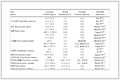
1 资料与方法 1.1 一般资料纳入标准:①年龄 > 18岁;②临床症状和影像学特征符合LDD诊断,且经规范的非手术治疗超过3个月症状无明显改善。排除标准:①伴有肿瘤、感染或急性创伤性骨折;②存在可能影响骨质的全身性疾病,如甲状腺功能亢进、风湿类疾病等。按照上述标准,纳入2016年1月—2019年12月采用腰椎融合术治疗的LDD患者136例,其中57例(78个椎间隙)术中采用rhBMP-2辅助治疗(试验组),79例(105个椎间隙)术中未使用rhBMP-2辅助治疗(对照组)。2组患者基线资料差异无统计学意义(P > 0.05,表 1),具有可比性。本研究经本院伦理审查委员会审核备案。
|
表 1 2组患者基线资料 Tab. 1 Baseline information of patients in 2 groups |
所有患者均采用后路腰椎椎间融合术(PLIF)治疗,共183个椎间隙。患者全身麻醉后取俯卧位,于病变节段做腰正中切口,逐层暴露脊柱并松解软组织,清理黄韧带,咬除增生骨质,充分解除神经压迫,之后切除椎间盘,使用刮匙处理终板软骨并尽可能保留骨性终板并置入椎弓根螺钉,在钛合金椎间融合器中植入自体棘突骨块,必要时加用同种异体骨或人工骨,以促进椎间融合。如有滑脱,对滑脱椎体进行提拉复位。将植骨后的融合器置入椎间隙,并将局部自体棘突骨块回填在融合器周围,采用C形臂X线机透视确认融合器位置正确。本研究中所有患者均未行髂骨植骨,术中使用的椎弓根螺钉和钛合金椎间融合器由上海三友医疗器械股份有限公司提供。
1.3 rhBMP-2使用方法术前充分告知患者目前rhBMP-2的研究现状,确保患者理解使用rhBMP-2的可能优势及潜在风险,充分确认患者对于术中使用rhBMP-2的意愿并签署知情同意书。本研究中使用的rhBMP-2由南京金陵药业股份有限公司提供,剂量参考Crandall等[10]的研究,每块吸收性明胶海绵为2 mg,在78个椎间隙中使用rhBMP-2的剂量为2 ~ 8 mg(表 2),平均5.31 mg。将rhBMP-2浸泡的明胶海绵松散卷起置于椎间融合器外,并使之尽可能位于最前方和椎间融合器和植骨的对侧,避免明胶海绵压缩以防止局部rhBMP-2浓度过高,每个椎间隙的明胶海绵数量视椎间高度而定。
|
|
表 2 各节段rhBMP-2使用剂量 Tab. 2 Dose of rhBMP-2 used in each segment |
采用疼痛视觉模拟量表(VAS)评分[11]、Oswestry功能障碍指数(ODI)[12]、并发症发生情况、影像学融合结果评估临床疗效。椎间融合的判定参考Lenke分级[13]:A级(绝对融合),双侧明显融合;B级(可能融合),单侧融合、对侧薄弱融合;C级(可能不融合),单侧薄弱融合并对侧假关节形成;D级(绝对不融合),双侧明显假关节形成或双侧植骨溶解。本研究通过2名接受过专业训练的脊柱外科医师独立双盲量化融合等级以减小误差,并进一步统计并发症发生率与rhBMP-2剂量是否相关。
1.5 统计学处理采用SPSS 25.0软件对数据进行统计分析。符合正态分布的计量资料以x±s表示,计数资料以例数或百分比表示;2组患者基线特征采用独立样本t检验或χ2检验,并发症的相对风险及融合情况的影响采用χ2检验,手术前后VAS评分和ODI比较采用配对t检验;以P < 0.05为差异有统计学意义。
2 结果所有手术顺利完成,患者随访(4.68±1.70)年。术后1个月、末次随访时2组VAS评分和ODI较术前显著改善,差异均有统计学意义(P < 0.05,表 3);末次随访时2组ODI较术后1个月进一步改善,对照组VAS评分较术后1个月进一步改善,差异均有统计学意义(P < 0.05,表 3)。2组间比较,术后1个月2组VAS评分差异有统计学意义(P < 0.05,表 3),其余各时间点VAS评分和ODI差异无统计学意义(P > 0.05,表 3)。试验组并发症发生率为12.3%,对照组为13.9%,2组并发症发生率差异无统计学意义(P > 0.05,表 3)。本研究参考既往文献报道[5],对rhBMP2剂量分为2 ~ 4 mg和6 ~ 8 mg 2个亚组,进一步统计并发症发生率与rhBMP-2剂量的相关性,结果显示,rhBMP-2剂量增加与并发症发生率无显著相关性(P > 0.05,表 4)。183个椎间隙术后按照Lenke分级标准判定,试验组椎间融合情况显著优于对照组,差异有统计学意义(P < 0.05,表 5)。
|
|
表 3 2组临床疗效指标比较 Tab. 3 Comparison of clinical efficacy indexes between 2 groups |
|
|
表 4 并发症与rhBMP-2剂量的相关性 Tab. 4 Correlation between complications and rhBMP-2 dose |
|
|
表 5 术后椎间融合情况 Tab. 5 Postoperative interbody fusion |
自美国食品药品监督管理局(FDA)批准rhBMP-2上市使用以来,该药在脊柱外科手术中的使用不断增加。有研究[14-16]表明,rhBMP-2在脊柱融合术中的应用效果不亚于髂嵴骨移植,并可减少疼痛和并发症。然而,rhBMP-2也会增加神经根炎、异位骨形成、骨溶解等并发症的发生,与其介导的炎性机制有关,因而限制了其应用[17]。本研究对使用rhBMP-2和未使用rhBMP-2的2组患者临床效果和融合情况进行了比较,结果显示,2组患者术后VAS评分和ODI均较术前显著改善,且对照组患者末次随访时的VAS评分较术后1个月进一步下降,而试验组患者术后1个月和末次随访时VAS评分无明显差异,提示rhBMP-2的使用可能促进了患者术后早期疼痛缓解和功能恢复。本研究中假关节形成发生率(Lenke分级C、D级)与既往报道[18]相近。本研究试验组A级融合率明显高于对照组(88.46% vs. 70.48%),D级融合率明显低于对照组(2.56% vs. 7.62%),提示rhBMP-2可促进椎间融合。另外,本研究2组手术并发症发生率无显著差异,且并发症的发生与rhBMP-2的使用无显著剂量依赖性。有研究[19]报道,在啮齿动物模型中使用rhBMP-2可诱导背根神经节的炎性反应。尽管本研究中神经炎的发生与rhBMP-2的使用及剂量之间无明显相关性,但当rhBMP-2剂量增加时,神经炎发生率由2.50%升高至10.53%,提示临床使用rhBMP-2时应充分评估其适应证,谨慎选择剂量。
本研究存在样本量较小、随访时间较短等局限性,可能导致结果偏倚。样本量的局限性,主要由于rhBMP-2的价格较高,且其使用尚存争议,对患者的使用意愿影响较大。随访时间方面,既往关于rhBMP-2的临床应用研究[20]最长观察时间为24个月,本研究进行了3年以上的临床随访,虽对既往研究进行了补充,但rhBMP-2的远期疗效及安全性仍须进一步观察。除此之外,对于神经根炎的判断,本研究难以根据随访记录确定神经根炎的严重程度和持续时间,未来研究应就此制订标准化方案,详细评估和追踪术后患者神经根炎的发生和转归。
综上,腰椎融合术中应用rhBMP-2辅助治疗LDD可改善融合情况,使用时须充分评估适应证、谨慎选择剂量以降低发生相关并发症的风险。
| [1] |
姜伟琪, 郭明明, 孟令志, 等. L4/L5节段椎弓根螺钉进针点选择的新方法[J]. 脊柱外科杂志, 2022, 20(6): 361-365. |
| [2] |
Khalid SI, Nunna RS, Maasarani S, et al. Association of osteopenia and osteoporosis with higher rates of pseudarthrosis and revision surgery in adult patients undergoing single-level lumbar fusion[J]. Neurosurg Focus, 2020, 49(2): E6. DOI:10.3171/2020.5.FOCUS20289 |
| [3] |
陈政宇, 晏怡果, 尹健, 等. 不同入路腰椎椎间融合术的应用现状及进展[J]. 脊柱外科杂志, 2022, 20(1): 58-62, 72. |
| [4] |
Halloran D, Durbano HW, Nohe A. Bone morphogenetic protein-2 in development and bone homeostasis[J]. J Dev Biol, 2020, 8(3): 19. DOI:10.3390/jdb8030019 |
| [5] |
Crandall DG, Revella J, Patterson J, et al. Transforaminal lumbar interbody fusion with rhBMP-2 in spinal deformity, spondylolisthesis, and degenerative disease—part 2:BMP dosage-related complications and long-term outcomes in 509 patients[J]. Spine(Phila Pa 1976), 2013, 38(13): 1137-1145. DOI:10.1097/BRS.0b013e3182880298 |
| [6] |
Moatz B, Tortolani PJ. Transforaminal lumbar interbody fusion and posterior lumbar interbody fusion utilizing BMP-2 in treatment of degenerative spondylolisthesis: neither safe nor cost effective[J]. Surg Neurol Int, 2013, 4(Suppl 2): S67-S73. |
| [7] |
Rihn JA, Makda J, Hong J, et al. The use of RhBMP-2 in single-level transforaminal lumbar interbody fusion: a clinical and radiographic analysis[J]. Eur Spine J, 2009, 18(11): 1629-1636. DOI:10.1007/s00586-009-1046-1 |
| [8] |
Wong DA, Kumar A, Jatana S, et al. Neurologic impairment from ectopic bone in the lumbar canal: a potential complication of off-label PLIF/TLIF use of bone morphogenetic protein-2(BMP-2)[J]. Spine J, 2008, 8(6): 1011-1018. DOI:10.1016/j.spinee.2007.06.014 |
| [9] |
王强. 临床随机对照研究BMP2在腰椎椎体间融合中的作用[C]. //浙江省医学会骨科学分会. 浙江省医师协会骨科医师分会. 2018年浙江省骨科学学术年会论文汇编, 2018: 1.
|
| [10] |
Crandall DG, Revella J, Patterson J, et al. Transforaminal lumbar interbody fusion with rhBMP-2 in spinal deformity, spondylolisthesis, and degenerative disease—part 1:large series diagnosis related outcomes and complications with 2-to 9-year follow-up[J]. Spine(Phila Pa 1976), 2013, 38(13): 1128-1136. DOI:10.1097/BRS.0b013e31828864e6 |
| [11] |
Huskisson EC. Measurement of pain[J]. Lancet, 1974, 2(7889): 1127-1131. |
| [12] |
Fairbank JC, Couper J, Davies JB, et al. The Oswestry low back pain disability questionnaire[J]. Physiotherapy, 1980, 66(8): 271-273. |
| [13] |
Lenke LG, Betz RR, Harms J, et al. Adolescent idiopathic scoliosis: a new classification to determine extent of spinal arthrodesis[J]. J Bone Joint Surg Am, 2001, 83(8): 1169-1181. DOI:10.2106/00004623-200108000-00006 |
| [14] |
Bellamy JT, Dilbone E, Schell A, et al. Prospective comparison of dysphagia following anterior cervical discectomy and fusion(ACDF)with and without rhBMP-2[J]. Spine J, 2022, 22(2): 256-264. DOI:10.1016/j.spinee.2021.09.001 |
| [15] |
Shah DS, Fisher MWA, Hurley RK, et al. Role of rhBMP-2 in posterior lumbar fusion[J]. Clin Spine Surg, 2022, 35(6): 229-232. |
| [16] |
Lad SP, Nathan JK, Boakye M. Trends in the use of bone morphogenetic protein as a substitute to autologous iliac crest bone grafting for spinal fusion procedures in the United States[J]. Spine(Phila Pa 1976), 2011, 36(4): E274-E281. |
| [17] |
Singh K, Nandyala SV, Marquez-Lara A, et al. Clinical sequelae after rhBMP-2 use in a minimally invasive transforaminal lumbar interbody fusion[J]. Spine J, 2013, 13(9): 1118-1125. |
| [18] |
Tannoury C, Bhale R, Vora M, et al. Pseudarthrosis following lumbar and lumbosacral fusion using the antepsoas technique[J]. Spine(Phila Pa 1976), 2021, 46(24): 1690-1695. |
| [19] |
Griffith MS, Shaw KA, Burke BK, et al. Post-operative radiculitis following one or two level anterior lumbar surgery with or without posterior instrumentation[J]. J Orthop, 2021, 25: 45-52. |
| [20] |
杨艳兰, 徐普. 重组人骨形态发生蛋白-2成骨的研究进展[J]. 现代医药卫生, 2021, 37(13): 2226-2230. |